· mezirme.com
What gives Mezirme a special place in Anatolian Alevism is that it is the centre of the Şah İbrahim Velî Ocak. An ocak is a lineage of dede families, the hereditary spiritual leaders of an Alevi community. Among those who have written about this ocak, the folklorist Prof. Fuat Bozkurt stands apart. He did not come to the village only as a researcher. He was born in Mamaş (today Soğukpınar) near Kangal, into a dede family that traces its descent to this ocak. His writing therefore carries the marks of both fieldwork and testimony from the inside.
This article is based on the two texts by Bozkurt that we have been able to read:
- His long piece “Şah İbrahim Veli Ocağı” (The Şah İbrahim Veli Ocak), published on his personal blog on 2 November 2017 (Bozkurt 2017). It draws on field trips between 1979 and 1989, and above all on a visit to Ballıkaya in the summer of 1986.
- His article “Various Alevi traditions according to the ocaks and the ‘Buyruk’ books”, published in issue 63 of Türk Kültürü ve Hacı Bektaş Velî Araştırma Dergisi (Bozkurt 2012). At the time of publication Bozkurt was a professor in the Faculty of Letters at Akdeniz University.
A note for readers: The views below are Fuat Bozkurt’s and are presented as his interpretations. mezirme.com neither adopts nor rejects them; where other sources say something different, we point it out. Bozkurt’s 2017 piece is not a peer-reviewed publication. All quotations are our translations from the Turkish original.
The Anatolian centre of a far-reaching ocak
Bozkurt opens his piece with the reach of the ocak:
With the widest following, the Şah İbrahim Veli Ocak is one of the Kızılbaş ocaks spread across Anatolia, Syria and Azerbaijan. Both in its range and in the way it is organised within Alevism, the ocak shows interesting features.
He is equally clear about Mezirme’s place within it:
The centre of the ocak in Anatolia is the village of Mezirme, now called Ballıkaya, in Malatya. It is known that the dedes of the ocak spread into Anatolia from here. The followers of the ocak are mostly Kızılbaş of Central and Eastern Anatolia.
Other studies agree on this point. Harun Yıldız’s article on the Amasya region and Hasan Coşkun’s study of the ocaks around Kangal also name Ballıkaya as the centre of the ocak (Yıldız 2012, p. 129; Coşkun 2015). For more, see our Faith and Culture page.
According to Bozkurt, the ocak’s sphere of influence is a broad arc running from around Aleppo to the Black Sea, with Malatya, Sivas and Tokat as its axis:
It begins around Aleppo and reaches as far as the Black Sea. The provinces of Malatya, Sivas and Tokat are considered its axis. One end of this area, which widens like a crescent, reaches Azerbaijan, where it meets the Shahsevan of South Azerbaijan.
The name and origin of the ocak: three views
The sources do not agree on who the Şah İbrahim of the ocak’s name was. Bozkurt’s text is especially useful because it sets two of these views side by side.
The Ardabil view. In Bozkurt’s own view, the ocak takes its name from Shaykh Sadreddin İbrahim, a shaykh of the Safavid order and the great-grandfather of Shah Ismail:
Although the ocak is a direct representative of Shah Ismail’s principles and teaching, it traces its name to Shah Ismail’s great-grandfather, Shaykh Sadreddin İbrahim. Even though the deep-rooted lodge of Shaykh Safi stands in Ardabil, the ocak adopts not him but his descendant İbrahim, two generations on, as its ancestor.
Bozkurt adds a passage taken from Abdülbâki Gölpınarlı’s book Tarih Boyunca İslâm Mezhepleri ve Şîîlik. It relates that Shaykh Shah İbrahim went on the pilgrimage with his father Khwaja Ali, returned to Ardabil after his father’s death, was recognised as leader by the followers of the Safavid order, and died in 851 AH (1447). Shaykh Junayd was his son, and Shah Ismail was his great-grandson (Bozkurt 2017).
The Niğde view. Bozkurt also reports a different view held by Nejat Birdoğan and Faruk Sümer. On this view, the ancestor of the ocak was Şah İbrahim Hacı, who lived in the Niğde area in the 14th century and is mentioned in a work completed by Kadı Ahmed in 1333. According to Birdoğan, this Şah İbrahim rose in revolt and was executed, and his sons and followers then migrated from Niğde to the Kangal area. Bozkurt quotes Birdoğan:
Whatever the case, the Şah İbrahim ocak is one of the finest creators of Asian traditions and a wholly Turkmen lineage. Because their circumstances forced them to, they linked their family trees to Karbala.
— Bozkurt 2017, quoting Nejat Birdoğan
The ocak’s own account. In the oral tradition of the ocak collected by Harun Yıldız, Şah İbrahim Velî was a descendant of Shaykh Safi al-Din and grew up in Ardabil. After coming to Anatolia he went first to the village of Sün near Elazığ, then to Eymür in Arguvan, and finally to Ballıkaya, where he founded his lodge (Yıldız 2012, pp. 129–130).
It is not this website’s place to decide which of these views is right. As Yıldız notes, the ocak’s genealogies, certificates of authority (icazetname) and Ottoman tax registers have not yet been seriously studied (Yıldız 2012, p. 129).
Organisation: pir, musahip and the Hacı Bektaş lodge
Much of Bozkurt’s piece deals with how the ocak is organised within Alevism. In his account, the ocak recognises the Dede Garkın Ocak as its pir (spiritual master) and the Seyyid Ali Kızıldeli Ocak as its musahip (ritual brother). He reads this arrangement as a deliberate choice:
The Dede Garkın ocak is one of the earliest ocaks to have come to Anatolia, perhaps the oldest. Naturally it holds an honoured place in Anatolian Alevism. […] It is at this stage, in the 17th–18th centuries, that the Şah İbrahim ocak, reorganising itself, builds up its following by drawing on the name of Dede Garkın, against the Hacı Bektaş lodge from which it had by then parted ways.
According to Bozkurt, the ocak has no seat (post) at the Hacı Bektaş lodge. Yet this distance is not aimed at Hacı Bektaş Velî himself, but at the way the lodge was run after the 16th century:
It is at odds with the Hacı Bektaş lodge, but not with Hacı Bektaş. It regards Hacı Bektaş as a great saint and has not the slightest quarrel with him. The problem lies with the lodge’s administration and practices, which changed after the 16th century.
Bozkurt traces this split to the changes made at the lodge under Balım Sultan. The principle of hereditary dedes was replaced by appointed “babas”, and the babas were forbidden to marry (celibacy, mücerretlik). The Kızılbaş tradition, to which the Şah İbrahim Ocak belongs, holds to descent. Here Bozkurt quotes the Buyruk, the book of Alevi teaching that he himself edited:
The Pir chapter of the Buyruk says that “only the leadership of one descended from Muhammad and Ali is valid”.
Another defining feature of the ocak, in Bozkurt’s view, is that it does not accept those who join the path later in life:
A person absorbs the Kızılbaş way only by being born into the community. This is also the guiding principle of the Şah İbrahim way. It is an identity acquired in one’s surroundings, lived like a mother tongue.
One lodge, two hillsides: Karadirek
Bozkurt devotes a separate section to the Karadirek lodge in the village. In his view, Karadirek grew in importance after the Hacı Bektaş lodge was absorbed into the Ottoman order in the 16th century:
It took on the role of strengthening Kızılbaş resistance and solidarity. Against the Hacı Bektaş lodge, which had come to terms with the Ottoman administration, it became the seat of the dedes appointed by the Turkmen of Iran.
He also records the story of how the village was founded. According to this oral account, the founder of the village, Şah Velî, loaded his ocak onto camels, left Ardabil and came to Mezirme (Bozkurt 2017). In the tradition collected by Yıldız, Şah Velî also appears as a 17th-century dede who restored the Karadirek lodge and increased the ocak’s following (Yıldız 2012, p. 130).
An observation Bozkurt made in 1986 sheds light on the history of the present Karadirek building as well. Describing the landslide in the old village and the state’s decision to move the village to the hilltop above, he notes:
The Karadirek lodge, too, has found its place in the new settlement. It is being built to plans drawn by my nephew Yusuf Ziya Bozkurt.
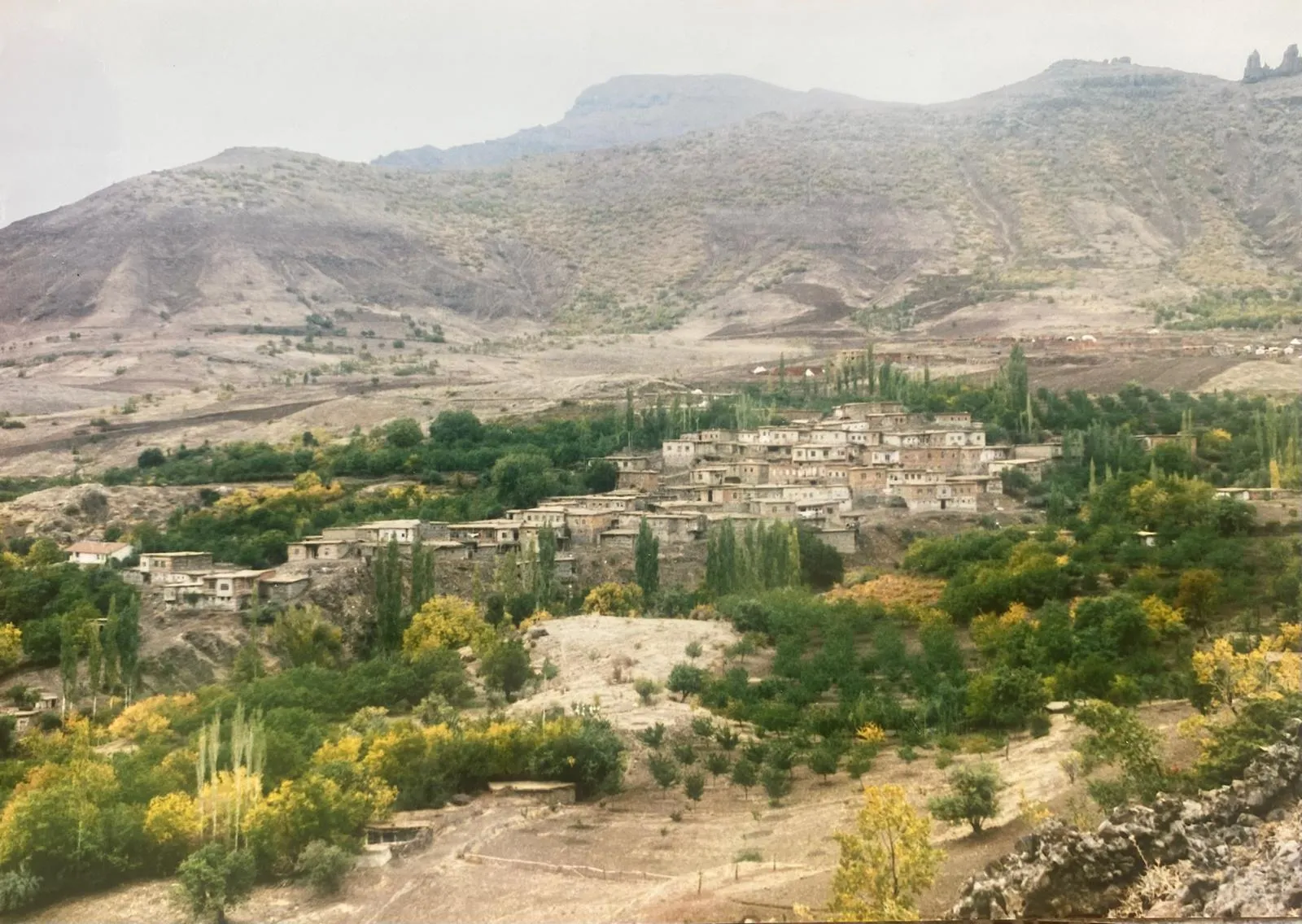
The old village, with new houses under construction on the plateau above. Approximately the second half of the 1980s, autumn; photographer unknown. The photograph has no known link to Bozkurt’s 1986 visit; it is thought to date from the years when the village was moved. Haydar Öztürk collection, MZ.2026.1.5.
Summer 1986: a collecting trip to Ballıkaya
The most vivid part of Bozkurt’s piece is his account of a trip in July 1986 to collect oral culture. The team included the folklorist Prof. İlhan Başgöz, the folklorist and photographer Oğuz Aktan, and Âşık Ali Kurt, a minstrel whose family had long-standing ties with Bozkurt’s own. Bozkurt describes the families’ shared past:
For three generations our ancestors led cem ceremonies in the Alevi villages around Malatya, Sivas and Tokat. My line sat on the post as “dede”, while Âşık Ali’s line performed the minstrel’s service known as zakirlik.
He likens old Mezirme to a fortress:
The village of Mezirme in the Hekimhan district of Malatya resembles a castle buried among the rocks. As though wishing to hide itself in the depths of the past, it lies concealed between two streams.
His diary-like pages also show the village as it was in those years. According to his notes, the 35-kilometre road between Malatya and Ballıkaya took three hours by village minibus. The houses of the old village stood on the two slopes of a valley, with orchards between them:
The shape of the dede village: houses of coloured stone set on the two slopes of a valley, orchards here and there among them. This is old Mezirme. Like the old people passing away one by one, old Mezirme too is dying.
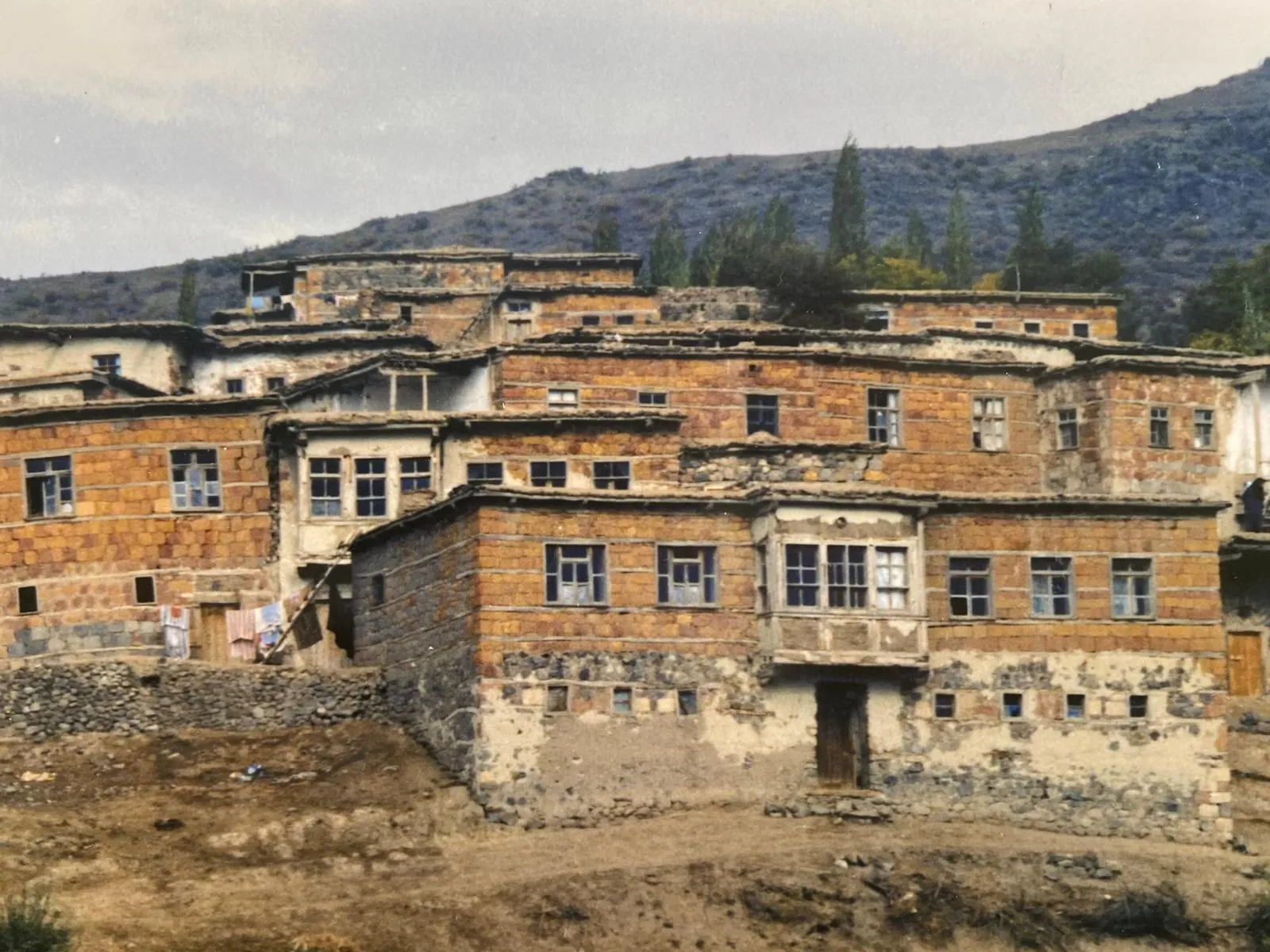
From the old village whose “houses of coloured stone” Bozkurt describes: houses built of reddish dressed stone and dark basalt. Approximately 1980s; photographer unknown. Haydar Öztürk collection, MZ.2026.1.3.
This is the settlement described on our Old Village page, as it was just before it was moved.
At the table of Encümen Hüseyin Yılmaz
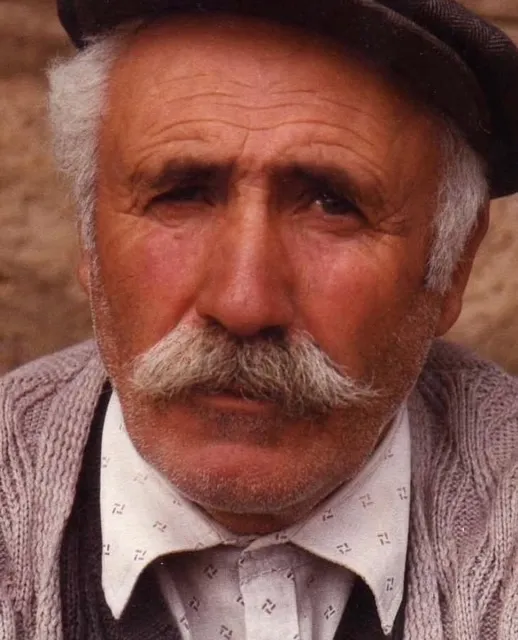
Encümen Hüseyin Yılmaz. Photograph: Haydar Öztürk, before 2002; Haydar Öztürk collection, MZ.2026.1.7. According to a memorial text written by Zeynep Oktay, Hüseyin Yılmaz founded the Ballıkaya Culture, Development and Tourism Association in 1993, began the building of the Ballıkaya Culture and Cem House (Karadirek) and died on 25 October 2002 (memorial text).
The team’s third evening in the village is spent at the house of Encümen Hüseyin Yılmaz. Bozkurt describes him as a host who served “with the pride of being the last representative of the Şah İbrahim Veli line”. Bozkurt recalls one moment from that evening’s conversation. When Âşık Ali began to sing, Encümen Hüseyin stopped him:
“Âşık, sing from Hatayi, from Pir Sultan. No Balım Sultan. […] I praise my own forefathers!”
Bozkurt writes that these words surprised him. At the time he had put forward, “somewhat hesitantly”, the view that the Bektashi–Kızılbaş split began under Balım Sultan. He took the fact that a villager who had never read his work said the same thing, drawing on tradition, as confirmation of his argument.
The same evening also brings debate. According to Bozkurt, the village’s generation that had trained as teachers at the Akçadağ Village Institute held both a strong sense of Turkish identity and the belief that their line went back to Ali. Başgöz and Bozkurt asked how these two beliefs fit together. At the end of a long discussion, one of the village teachers, İbşir, replied:
“Every people in the world has its beliefs. People cannot do without them. Belief brings people more peace. These are our beliefs. Do not dig any deeper.”
The night ends with the semah, the ritual dance. To the sound of Âşık Ali’s saz, villagers over sixty rise to turn the semah. According to Bozkurt, Âşık Ali then plays “Saba mülkü”, a poem that holds a special place among the Alevis of Malatya, Sivas and Tokat and is believed to tell of Shah Ismail’s victories:
Saba mülkün verir bade
Dağıttıkça saba zülfün
Yıkar Çin mülkünü ahır
Harap eyler hata zülfün(roughly: “The morning breeze gives the realm wine / as it scatters your locks; / in the end your locks topple the realm of China / and lay Cathay to waste”)
Bozkurt notes that Alevi minstrels attribute this poem to Bayburtlu Zihni. But since Bayburtlu Zihni had no historical connection with Shah Hatayi, he argues, either the poem is not by Zihni or it was not written for Hatayi (Bozkurt 2017).
Documents: family trees and a letter
Bozkurt also discusses documents held by the ocak families. What he writes about them is an important lead until the documents themselves can be published.
A notarised family tree. According to Bozkurt, Hüseyin Yılmaz of the Şah İbrahim line had the ocak’s family tree transcribed into the modern alphabet in 1986 and certified by the 11th Notary of Ankara (No. 44178). Bozkurt gives it as a line that begins with Abu Talib and runs through the shaykhs of Ardabil and the Safavid shahs to Şah Paşa (Paşoğ Dede), and after 1935 to the Öztürk, Oktay, Kutlu and Yılmaz families. He then comments:
Like all family trees, it is full of names that do not agree with one another. It contains next to no living information.
Bozkurt writes that the villagers held family trees drawn up in Ardabil and had them translated from Ottoman Turkish by a sworn translation office in Ankara. He quotes some passages from these translations. They are dated 1321 AH (1903 CE) and mention a visit to the lodge in Ardabil and the granting of the title of halife (deputy). Bozkurt also saw a family tree running from Adam to the Twelve Imams hanging in the Karadirek lodge.
A letter sent to Aydın. A document that Bozkurt says he came across in Ballıkaya shows the ocak’s ties reaching the Aegean in the late 19th century. The letter is addressed to the babas and followers in the province of Aydın. It declares a claim to the office of halife made by someone from the Ankara area to be invalid. In Bozkurt’s reading, the letter names the ocak’s envoys in this line:
from the first rank of notables, from the Başağa-zade, Hacı Ağa and Hasan Ağa […] have been sent to that region.
The letter closes with the names Veli Ağazade, Ali Ağazade, Mahmut Ağazade, Selman Ağazade, Ebuseyf Ağazade and Ahmed Ağazade and a seal. Bozkurt dates it to 1898. The phrase “Başağa-zade” is notable in light of the Başağalar family tree on this website. Matching the people in the letter with names in that tree, however, would require seeing the original document. Bozkurt’s own reading is:
The document shows that at the end of the 19th century the Şah İbrahim ocak still kept its hold over its followers.
In 1989 Bozkurt and Oğuz Aktan visited Sarıcaova (Kuyucak, Aydın), one of the places the letter was addressed to. In his diary entry of 7 July 1989 he writes that the village’s Şah İbrahim followers had “always remained under the guidance of the dedes from Mezirme (it was a regular stop of Hacı Ali Dede)” (Bozkurt 2017).
Mezirme in poetry
Bozkurt observes that, set beside the dry lists of names in family trees, poems “let you breathe and tell far more”. His piece contains two poems that name Mezirme directly.
The first is by a poet with the pen name İsyani. Each verse ends with the refrain “Devah edin Mezirme’ye varınca” (“find your cure when you reach Mezirme”):
Şeyh Safi’nin gediğine çıkınca
Erdebil’in gonca gülün kokunca
Ballıkaya’nın balı akınca
Devah edin Mezirme’ye varıncaBelini vermiş taşa kayaya
Şah İbrahim dersi verip okuta
Yılan boğazından buğday akıta
Devah edin Mezirme’ye varınca(roughly: “When you climb to Shaykh Safi’s pass, / when you smell Ardabil’s rosebud, / when Ballıkaya’s honey flows, / find your cure when you reach Mezirme. // Leaning its back against stone and rock, / where Şah İbrahim gives his lesson, / where wheat flows from the snake’s throat, / find your cure when you reach Mezirme.”)
The second is a long satirical poem by Yemenli, a minstrel from Ballıkaya who lived in the late 19th century, criticising the dedes of his day. Bozkurt relates that Yemenli went to Yemen as a soldier and, being literate and clever, rose to officer rank there. After returning to his village he wrote poems under the pen name Yemenli. Most of them have been lost. One verse of the satire:
Bilmezsiniz nedir ehli halimi
Gücüm yetmez nidem, hüküm galibi
Bin senelik Şah İbrahim talibi
Çundurdunuz yörüklere dedeler(roughly: “You do not know the state of the people of the path; / I lack the strength, what can I do, the ruling prevails. / The thousand-year followers of Şah İbrahim, / O dedes, you have … to the nomads.” The dialect verb çundurmak in the last line is left untranslated because its meaning is uncertain.)
Levent Çoban’s study of music in Hekimhan also names Yemenli among the minstrels raised in Ballıkaya (Çoban 2018, p. 79).
Vaylöğ Dede
Bozkurt’s peer-reviewed article mentions a dede from Mezirme in the context of Alevi birth customs:
Some dedes became famous for the power of their breath. One of them is Vaylöğ Dede from the village of Mezirme in Malatya. […] Vaylöğ, who came from the Şah İbrahim Veli ocak and whose real name was Mustafa Öztürk, granted children through his prayers to young brides who could not conceive, in many villages in the Malatya–Sivas–Tokat triangle. The boys born took his name.
The name in the quotation is mistaken: Vaylöğ Dede’s real name was Mustafa Tuna (Oktay, email); see his page.
In his blog piece Bozkurt adds that he remembers this dede from his childhood “as if in a dream”. He also writes that children born through his prayers carried the nickname Vaylöğ alongside the name Mustafa (Bozkurt 2017). Bozkurt regards this belief as shamanic in origin. We have not yet found a source confirming that this dede is the person of the Vayloğ Dede Tomb, a place of pilgrimage in Ballıkaya today, so we keep the two apart.
The ocak’s other homes
Bozkurt also lists traces of the ocak beyond Mezirme (Bozkurt 2017):
- Soğukpınar (Mamaş), Kangal: four families with the surnames Yıldırım, Şimşek, Bozkurt and Yüzübenli are said to descend from the ocak. Bozkurt publishes his own family’s tree. Coşkun likewise records Şah İbrahim dedes in Mamaş as well as in Mezirme (Coşkun 2015).
- Hamal, Kangal: according to Bozkurt, the family tree held by the Akın family, which is said to begin in Ballıkaya, differs in some respects from the others.
- Çubuk, Ankara: according to Bozkurt, the custom of burying the inedible organs and the skin of the sacrificial animal is found only in the villages around Çubuk that follow the ocak.
- Sarıcaova, Aydın: one of the places the letter mentioned above was addressed to.
Why it matters
Fuat Bozkurt’s writing on the Şah İbrahim Velî Ocak is valuable in two ways. On the one hand, it offers a strong, debatable interpretation of the ocak’s place within Alevism, one that stresses its bond with Ardabil, its distance from the Hacı Bektaş lodge and a deliberate form of organisation. On the other hand, through notes taken in Mezirme in the summer of 1986, the people they name, the poems sung and the documents seen, it leaves a testimony that would be hard to gather today.
Part of this testimony, such as the Aydın letter, the notarised family tree and the Ardabil records, still awaits confirmation from the original documents. If you hold one of these documents and, as its owner, are willing to have it published, please contact us through our contribute page or at mezirme@meztech.llc. Every document you send is added with a note of where it came from and under what permission it is published.
Sources
- Fuat Bozkurt, “Şah İbrahim Veli Ocağı”, personal blog, 2 November 2017 (in Turkish).
- Fuat Bozkurt, “Ocaklara ve ‘Buyruk’ Kitaplarına Göre Çeşitli Alevi Gelenekleri”, Türk Kültürü ve Hacı Bektaş Velî Araştırma Dergisi, no. 63 (2012), pp. 385–410 (in Turkish).
- For full details of the other sources used on this site, see the Sources page.
The Turkish original of this article is registered on Origmark. Time of registration and originality record:
Sources for this page
- Academic publicationFuat Bozkurt (2017). Şah İbrahim Veli Ocağı. Fuat Bozkurt's personal blog (Blogger), 2 November 2017. fuatbozkurt.blogspot.com Accessed: 13 October 2026.Not a peer-reviewed publication. These are the author's notes and assessments based on his field trips between 1979 and 1989, including the 1986 visit to Ballıkaya. Quotations are translated from the Turkish original.
- Academic publicationFuat Bozkurt (2012). Various Alevi traditions according to the ocaks and the “Buyruk” books. Türk Kültürü ve Hacı Bektaş Velî Araştırma Dergisi, no. 63, pp. 385–410. dergipark.org.tr Accessed: 13 October 2026.The printed issue is dated 2012; DergiPark lists the online publication date as 15 January 2013.
- Academic publicationHarun Yıldız (2012). Şah İbrahim Velî Ocağı'nın Amasya Yöresindeki İzdüşümleri. Türk Kültürü ve Hacı Bektaş Velî Araştırma Dergisi, no. 63, pp. 127–138. dergipark.org.tr Accessed: 12 October 2026.
- Academic publicationHasan Coşkun (2015). Kangal ve Çevresindeki Alevi Ocakları. Türk Kültürü ve Hacı Bektaş Velî Araştırma Dergisi, no. 75. dergipark.org.tr Accessed: 12 October 2026.The article places the village in Arguvan district. Administratively, Ballıkaya belongs to Hekimhan.
- Academic publicationLevent Çoban (2018). Hekimhan Müzik Kültürü Üzerine Bir Araştırma. İnönü Üniversitesi Kültür ve Sanat Dergisi, vol. 4, no. 1, pp. 77–84. dergipark.org.tr Accessed: 12 October 2026.
- Family archiveZeynep Oktay (2002 sonrası). Ve bu köyden bir Hüseyin Yılmaz geçti (Encümen Hüseyin Yılmaz için anma metni). Family archive; final version sent by the author's family on 14 October 2026. The full text is on the person's page on mezirme.com.. mezirme.com Accessed: 14 October 2026.A memorial text written by the family; its contents are used on this site as reported information.
- Family archiveFatoş Oktay (2026). Email to mezirme.com (on the name of Vaylöğ Dede). Personal communication, 16 October 2026. Accessed: 16 October 2026.A correction sent by a reader from the village; used on this site as reported information.